
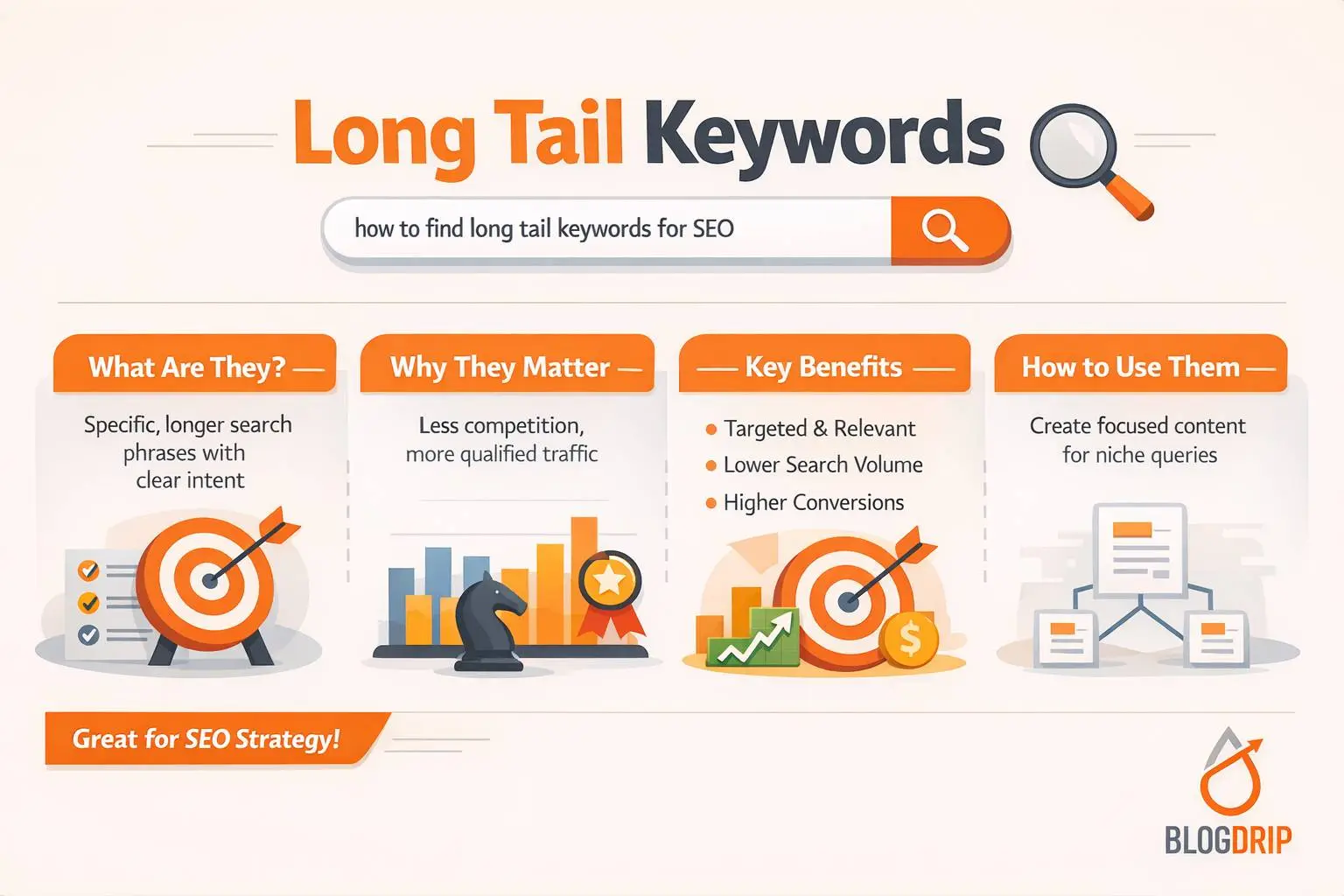
Long Tail Keywords: What They Are and Why They Matter in SEO
Long tail keywords are more specific search phrases that usually have lower search volume than broad head terms, but clearer intent and stronger topical focus. In SEO, they are often some of the most practical keywords to target because they help connect content to precise search needs.
A lot of businesses underestimate long tail keywords because they focus too heavily on volume. Broad keywords look more attractive in a tool, but they are often more competitive, less specific, and harder to convert into useful traffic. Long tail keywords tend to work differently. They may attract fewer searches individually, but they often bring visitors who know more clearly what they want.
That makes them especially important for websites building authority through a pillar-and-cluster model. A broad topic like Keyword Research may belong on a pillar page, while long tail keywords often shape the supporting cluster content that adds depth, relevance, and stronger intent matching. Your broader Keyword Research guide already explains how keyword targeting supports site structure and topical authority. This page focuses more specifically on what long tail keywords are, why they matter, and how to use them effectively.
What Are Long Tail Keywords?
Long tail keywords are longer, narrower, and more specific search queries.
They are called “long tail” not because they must contain a certain number of words, but because they tend to sit in the long tail of search demand. In other words, each query may be searched less often than a broad head term, but there are many more specific searches overall than people often realize.
For example:
- “keyword research” is a broad keyword
- “long tail keywords” is more focused
- “how to find long tail keywords for SEO” is a more specific long tail query
The key difference is not only length. It is specificity and intent.
A broad term may reflect a wide range of possible needs. A long tail keyword usually narrows the topic enough that the searcher’s goal becomes easier to interpret. That makes it easier to build content that matches what the user actually wants.
Why Long Tail Keywords Matter
Long tail keywords matter because they improve targeting, reduce ambiguity, and often create more realistic SEO opportunities.
They reflect clearer search intent
One of the main advantages of long tail keywords is that they usually make user intent more obvious.
A user searching for “SEO” could mean almost anything. They may want a definition, a service, a guide, a course, or a tool. A user searching for “best long tail keywords for local SEO” is signaling something much clearer.
That clarity matters because intent alignment is central to modern SEO. The better you understand what the searcher wants, the easier it is to create the right page.
They are often less competitive
Broad keywords usually attract more competition because everyone wants visibility on high-volume terms. Long tail keywords are often less crowded, which can make them more realistic targets, especially for newer websites or sites still building topical authority.
Less competition does not always mean easy. Some long tail keywords still sit in competitive spaces. But in general, more specific queries create a better chance to compete on relevance rather than pure authority.
They support stronger content relevance
Long tail keywords encourage focused content. Instead of writing a vague, catch-all article, you can create a page that addresses one clearly defined need.
This usually improves topical precision. It can also lead to stronger engagement because the page feels closer to what the user expected when they clicked.
They fit naturally into a cluster strategy
In a pillar-and-cluster model, long tail keywords are often ideal for cluster pages.
A pillar page covers the broad subject. Cluster pages then address the narrower supporting questions, use cases, or subtopics that sit underneath it. Long tail keywords help define those supporting pages clearly, which strengthens internal linking and topical depth.
How Long Tail Keywords Work in SEO
Long tail keywords work by narrowing the match between query and content.
Search engines aim to rank pages that best satisfy the search. When a query is broad, many different page types may compete. When a query is narrow, the best match is often easier to identify.
That creates an opportunity for focused content.
They narrow the topic
A long tail keyword gives a page a clearer subject boundary. Instead of trying to rank for an entire category, the page can go deeper on one angle of the topic.
That usually improves clarity for both users and search engines.
They improve matching between query and page
When a page aligns closely with a specific query, it is easier for the search engine to understand why it belongs in the results. That does not mean you should create a separate page for every keyword variation, but it does mean that specificity can improve relevance when the search intent is distinct.
They help capture qualified traffic
Long tail traffic is often more qualified because the searcher has already narrowed the need. They may be further along in research, closer to a decision, or simply more precise about the problem they want solved.
For informational content, that means higher relevance. For commercial content, it can also mean stronger conversion potential.
Important Characteristics of Long Tail Keywords
Not every longer phrase is strategically useful, so it helps to understand what makes long tail keywords valuable.
Specificity
A good long tail keyword narrows the topic meaningfully. It usually points to a clear question, use case, audience, or problem.
For example, “keywords” is too broad to guide a strong page on its own. “Long tail keywords for ecommerce SEO” offers much more direction.
Intent clarity
The best long tail keywords make it easier to identify what the user is trying to do. This helps you choose the right content format, whether that is a guide, tutorial, landing page, or comparison article.
Lower individual search volume
Most long tail keywords have lower volume than broader terms. That is normal and not a weakness by itself.
SEO value does not come from volume alone. A highly relevant, lower-volume query can be more useful than a high-volume term with vague or mixed intent.
Stronger topical fit
Long tail keywords often align well with specialized businesses, niche topics, and detailed educational content. They give websites a way to build relevance in areas where broader terms may be too competitive or too general.
Common Mistakes With Long Tail Keywords
Long tail keywords are useful, but they are often misunderstood.
Assuming they matter only for small sites
It is true that long tail keywords are often especially helpful for newer websites, but they are not only for beginners. Established sites also rely on them to strengthen topical coverage, capture niche demand, and support content depth.
Focusing only on word count
A long phrase is not automatically a good long tail keyword. The real issue is whether the query is specific, useful, and distinct in intent.
Creating one page for every minor variation
This is one of the most common mistakes. Many long tail phrases share the same intent and should be grouped together on one strong page. Splitting them apart can create thin content and keyword cannibalization.
Ignoring the wider topic structure
Long tail keywords work best when they support a broader content strategy. If they are targeted randomly, without a connection to pillar topics or internal linking, much of their value gets lost.
Practical Guidance for Using Long Tail Keywords Well
The best way to use long tail keywords is to treat them as strategic content opportunities, not just easy wins.
Start by identifying broad topic areas that matter to your audience and your business. Then look for specific long tail queries within those topics that reveal clear intent or unanswered needs.
Once you find those opportunities, review the search results carefully. Ask whether the query deserves its own page or whether it fits naturally within an existing article. This step matters because not every long tail keyword needs a dedicated URL.
In a cluster structure, long tail keywords often help define supporting articles. A broad pillar page on Keyword Research can link to more focused pieces on search intent, long tail keywords, keyword mapping, and related subtopics. That is usually a stronger strategy than forcing all related terms into one broad guide.
It is also important to keep expectations realistic. Long tail keywords are valuable because they improve fit and relevance, not because they guarantee rankings. They still require strong content, sound internal linking, and a technically healthy site.
Timing and Expectations
Long tail keywords can produce results more efficiently than broad terms in some cases, but they are not a shortcut.
Their main advantage is strategic. They help you target queries where intent is clearer and competition may be lower. That often leads to better opportunities for ranking, especially when supported by a well-structured cluster.
For established sites, adding or refining long tail content can improve visibility by filling topic gaps and strengthening internal relevance. For newer sites, long tail keywords are often one of the most realistic ways to begin gaining traction before broader terms become attainable.
Still, results depend on execution. Long tail targeting improves the odds, but it does not replace the need for quality content and consistent SEO work.
Conclusion
Long tail keywords are specific search queries that help narrow the gap between what users search for and what a page delivers.
They matter because they often reflect clearer intent, create more realistic ranking opportunities, and support stronger content relevance. In a pillar-and-cluster strategy, they are especially useful for shaping focused supporting pages that deepen topical authority without diluting the broader structure.
Used well, long tail keywords help SEO move away from broad assumptions and toward more precise targeting. That is why they remain such an important part of practical, sustainable search strategy.