
Types of Keywords: A Clear Guide for SEO Strategy
Understanding the types of keywords is essential if you want SEO content to be relevant, structured, and strategically useful. Many websites know they need keywords, but far fewer understand that not all keywords serve the same purpose. Some reflect broad topical interest, some show clear buying intent, and others indicate that a searcher is still gathering information.
That distinction matters because SEO is not just about finding phrases with volume. It is about matching the right query to the right page at the right stage of the search journey. If you misunderstand the types of keywords you are targeting, you are more likely to publish the wrong kind of content, misread intent, or build pages that compete with each other.
For a site built around a pillar-and-cluster model, keyword types help define content roles. A broad topic may belong on a pillar page, while more specific or intent-driven queries often work better as supporting cluster content. Your Keyword Research pillar page already explains how keyword strategy supports structure, intent, and topical authority. This page focuses more narrowly on the main types of keywords and how to use them correctly in SEO planning.
What Are the Types of Keywords?
The types of keywords are the different categories of search terms used to describe intent, specificity, and strategic function in SEO.
In practical terms, classifying keywords helps you answer questions like these:
- Is this keyword broad or specific?
- Does it reflect informational or commercial intent?
- Should it be targeted on a pillar page, a cluster article, or a conversion-focused page?
- Is this keyword useful for awareness, consideration, or action?
There is no single categorization model used by everyone, but most SEO work relies on a few core keyword groupings. The most useful way to understand them is by looking at keyword types from three angles:
- by length and specificity
- by search intent
- by strategic role in content planning
That approach is more useful than memorizing isolated definitions because it reflects how keywords actually function in real SEO workflows.
Why the Types of Keywords Matter
Knowing the types of keywords matters because it improves targeting, content planning, and site structure.
Without this understanding, keyword research tends to become flat. You end up with a list of phrases, but no clear framework for deciding what to do with them. That often leads to weak content decisions, such as targeting highly commercial queries with informational blog posts or creating separate pages for terms that should be grouped together.
They improve intent matching
One of the clearest reasons keyword types matter is that they help you interpret user intent more accurately.
A search for “what are SEO keywords” is very different from a search for “best SEO agency” or “buy keyword tool subscription.” Each query implies a different need, which means each one requires a different kind of page.
Recognizing keyword type helps you avoid mismatches between searcher expectations and page format.
They support better page planning
A broad keyword may be appropriate for a foundational guide, while a narrow long-tail term may deserve a focused cluster page. Some keywords belong on product or service pages, while others work better in educational content.
When you understand keyword types, you can assign them more effectively across the site instead of treating every term as equal.
They reduce cannibalization and thin content
Many content problems come from poor keyword classification. Teams create multiple pages around slight keyword variations without realizing the terms share the same intent.
Understanding keyword types makes it easier to group related terms, consolidate overlap, and build stronger pages around real topic clusters.
Types of Keywords by Length and Specificity
One of the most common ways to classify keywords is by how broad or specific they are.
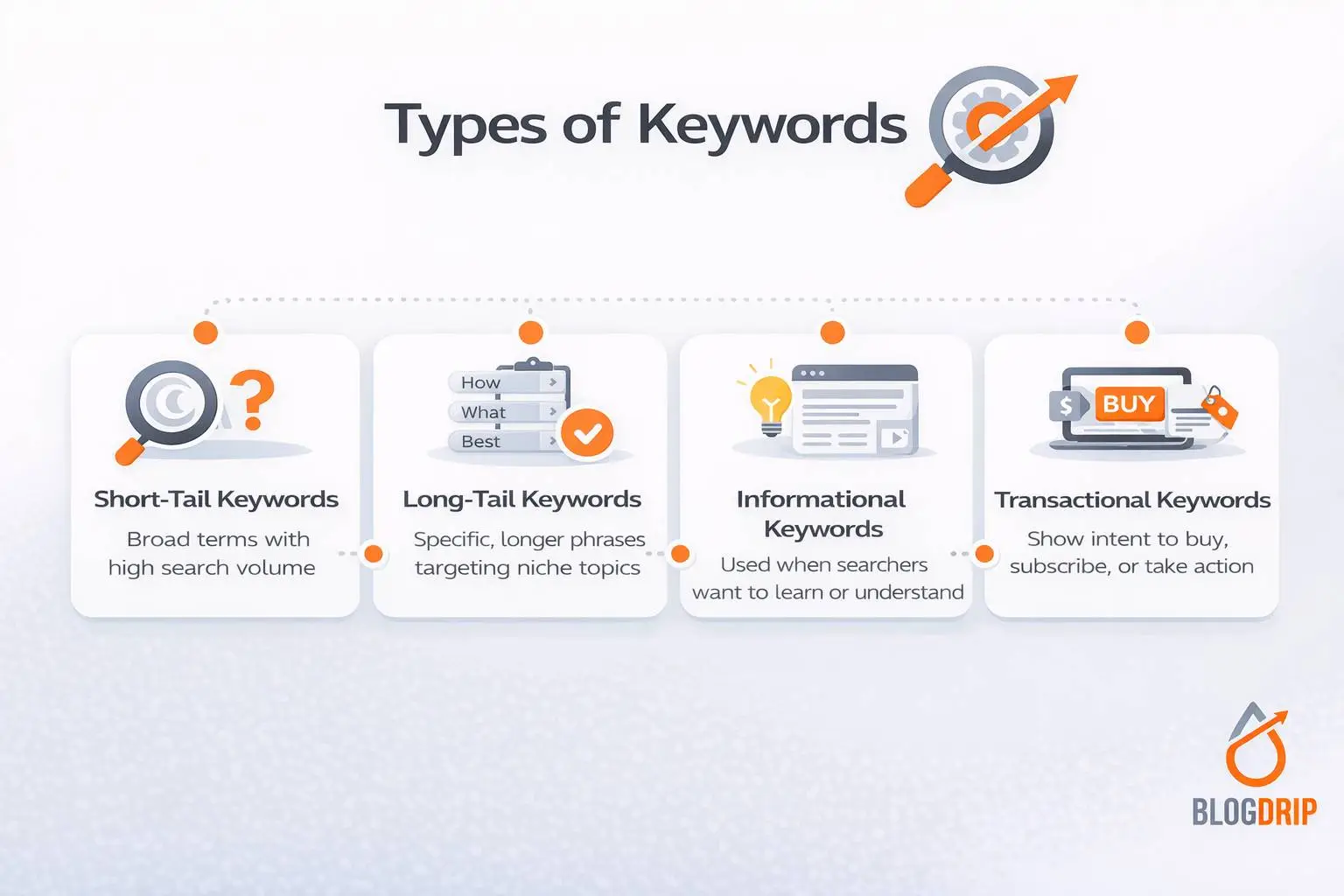
Short-tail keywords
Short-tail keywords are broad search terms, usually one or two words long. Examples include “SEO,” “keyword research,” or “types of keywords.”
These keywords often have higher search volume, but they also tend to be more competitive and less precise. They can be useful for pillar pages or broader educational content, but they are not always the best target for newer or lower-authority websites.
The challenge with short-tail keywords is ambiguity. A broad term may attract many searches, but those searches may reflect mixed intent.
Long-tail keywords
Long-tail keywords are more specific phrases, usually longer and narrower in focus. Examples might include “types of keywords in SEO,” “different keyword types for content strategy,” or “how to choose keyword types.”
These keywords often have lower search volume, but they usually offer clearer intent and stronger alignment with a specific page. They are especially useful for cluster content because they let you answer a focused question in more depth.
Long-tail keywords are often where SEO strategy becomes more practical. They may not look as attractive in raw volume terms, but they can produce better intent matching and more realistic ranking opportunities.
Mid-tail keywords
Mid-tail keywords sit between broad head terms and highly specific long-tail phrases. They are still relatively common search terms, but they provide more context than a short-tail keyword alone.
For example, “SEO keywords” is broader than “types of keywords in SEO,” but more focused than just “keywords.”
These terms often make strong targets for cluster pages when the topic is specific enough to deserve its own article but broad enough to support meaningful coverage.
Types of Keywords by Search Intent
Keyword type is also closely tied to what the searcher is trying to do.
Informational keywords
Informational keywords are used when the searcher wants to learn something, understand a concept, or solve a problem. These often include words like what, why, how, guide, examples, or tips.
Examples include:
- what are keyword types
- how to find SEO keywords
- why keyword research matters
Informational keywords are typically best served by blog articles, guides, glossaries, or educational cluster pages. This page itself targets an informational keyword.
Navigational keywords
Navigational keywords are used when someone is trying to reach a specific website, brand, or page.
Examples include branded searches such as a company name, product name, or login-related search. These are usually less relevant for non-branded editorial SEO unless the site has strong branded demand or comparison content around known platforms.
Commercial keywords
Commercial keywords suggest that the user is evaluating options before making a decision. These often include modifiers such as best, top, review, comparison, or alternatives.
Examples include:
- best keyword research tools
- top SEO platforms
- keyword tool comparison
These keywords often belong on comparison pages, reviews, or solution-focused content rather than purely educational articles.
Transactional keywords
Transactional keywords signal strong intent to act. These searches often involve words like buy, pricing, service, quote, demo, or subscription.
Examples include:
- buy SEO software
- keyword research service pricing
- request SEO consultation
These should usually be targeted by service pages, product pages, or highly commercial landing pages.
Types of Keywords by Strategic SEO Function
Beyond length and intent, keywords can also be grouped by the role they play in a content strategy.
Primary keywords
A primary keyword is the main search term a page is built around. It defines the core topic and the main intent the page aims to satisfy.
For this page, the primary keyword is “types of keywords.”
A page should have one main target, even if it also ranks for related variations.
Secondary keywords
Secondary keywords are closely related terms that support the page topic. These may be variations, subtopics, or semantically related phrases that strengthen topical relevance.
For example, a page on types of keywords may also naturally include phrases related to informational keywords, transactional keywords, long-tail keywords, and keyword intent.
Secondary keywords should support the main topic, not pull the page in a different direction.
Branded keywords
Branded keywords include a company, product, or brand name. These can be valuable when a business has existing recognition or when users are specifically searching for that brand.
Branded queries are usually easier to win if the brand is established, but they serve a different purpose from broader non-branded SEO targeting.
Non-branded keywords
Non-branded keywords do not include a company name. These are often central to SEO growth because they attract users who may not know the brand yet.
For most content-driven SEO strategies, non-branded keywords are where topic expansion and new audience acquisition happen.
Common Mistakes When Working With Keyword Types
Understanding keyword types is useful only if it improves decisions. A few mistakes show up repeatedly in SEO planning.
Treating all keyword types the same
Not every keyword should be handled with the same page format. An informational query and a transactional query do not belong on the same kind of page.
Confusing specificity with value
Broad keywords are not automatically better. In many cases, specific long-tail keywords are more useful because they reflect clearer intent and create more realistic ranking opportunities.
Creating separate pages for every variation
Some keyword differences are meaningful. Others are not. If two terms share the same intent and can be answered on one page, splitting them apart may create weak content and cannibalization.
Ignoring the wider site structure
Keywords should not be assigned in isolation. A website using a pillar-and-cluster model needs to think about how broad and narrow terms work together across multiple pages.
Practical Guidance for Using Keyword Types Correctly
A good approach is to classify keywords before assigning them to content.
Start by asking:
- How broad is this keyword?
- What is the likely intent?
- Does it fit a pillar page, a cluster page, or a commercial landing page?
- Can related terms be grouped on one page?
This helps turn research into structure.
In practice, broad informational keywords often support pillar content, while narrower long-tail and question-based phrases make strong supporting cluster pages. Commercial and transactional keywords usually belong elsewhere in the site architecture.
It is also important to remember that keywords are not just labels. They are part of how you define page purpose. A page should not exist simply because a phrase appears in a tool. It should exist because the keyword reflects a real need, a clear intent, and a distinct role within the site’s topical structure.
Timing and Expectations
Understanding the types of keywords improves strategy immediately, but results still depend on execution.
The benefit usually shows up first in better decisions: clearer content briefs, better page targeting, stronger internal linking, and less duplication. Rankings and traffic gains come later as those improvements are implemented.
For established sites, refining keyword classification can improve performance relatively quickly when it leads to consolidation, clearer intent matching, or better topic coverage. For newer sites, the benefit is still substantial, but it usually builds more gradually.
Conclusion
The types of keywords matter because they help you understand not just what people search for, but how those searches should shape your SEO strategy.
Some keywords are broad, some are specific, some are educational, and some are close to conversion. Each type serves a different purpose, and strong SEO depends on treating them differently.
When you understand keyword types clearly, you make better decisions about targeting, page format, internal structure, and content priorities. For a website building authority through topic clusters, that turns keyword research from a list of phrases into a framework for smarter SEO planning.