
Content Optimization Tools: How to Use the Right Tools Without Losing Strategic Focus
Content optimization tools can be extremely useful, but they are also easy to misuse. Many teams buy a platform, follow its recommendations line by line, and assume that better scores will automatically lead to better rankings. In practice, that is not how SEO works.
A tool can help you identify opportunities, improve consistency, and speed up workflows. It can show missing subtopics, weak internal linking, readability issues, and technical content gaps. What it cannot do on its own is make strategic decisions. It does not fully understand brand positioning, search intent nuance, business goals, or the difference between helpful content and content that is merely optimized on paper.
That is why this topic matters. Businesses often invest in content optimization tools before they have a clear process for using them. The result is content that becomes more formulaic rather than more useful.
This is Cluster page content, so the goal here is focused. This article explains what content optimization tools are, why they matter, how they work, what types of tools are most relevant, what common mistakes to avoid, and how to use them in a way that supports real SEO performance.
What Are Content Optimization Tools
Content optimization tools are software platforms or features that help improve the quality, relevance, structure, and performance potential of content.
In practical terms, these tools assist with tasks such as:
- identifying keyword and topic opportunities
- analyzing search intent patterns
- reviewing on-page SEO elements
- finding content gaps
- improving readability and structure
- suggesting internal link opportunities
- monitoring content performance over time
Some tools focus narrowly on one function, such as keyword clustering or content briefs. Others are broader platforms that combine SERP analysis, topical recommendations, scoring systems, competitor comparisons, and workflow management.
The important point is that content optimization tools are support systems. They help you make better decisions, but they do not replace editorial judgment or SEO strategy.
Why Content Optimization Tools Matter
Content optimization tools matter because manual SEO work becomes harder to scale as a site grows. A few pages can be reviewed by hand. A large content library cannot be managed effectively without systems.
They improve efficiency
A good tool shortens the time needed to diagnose content weaknesses. Instead of reviewing every SERP manually, collecting headings by hand, or comparing multiple competing pages one by one, a tool can surface patterns faster.
That does not remove the need for analysis, but it makes the process more efficient.
They help standardize quality
When multiple writers or stakeholders are involved, content quality often becomes inconsistent. Content optimization tools can help create clearer standards around structure, topical depth, page completeness, and optimization hygiene.
They reveal opportunities that are easy to miss
A page may be underperforming because of missing subtopics, weak keyword alignment, or thin internal support. A good tool can surface those issues faster than a manual review alone.
They support larger content systems
For a pillar-and-cluster model, consistency matters. Content optimization tools can help maintain topical coverage across clusters, reduce gaps, and support more strategic internal linking.
How Content Optimization Tools Work
Content optimization tools work by comparing your content against signals that suggest relevance, completeness, or performance potential.
Most tools pull from some combination of search results, page content, keyword data, entity patterns, topical coverage, readability metrics, and page-level SEO checks.
They Analyze the Search Landscape
Many tools begin by reviewing pages that already rank for a target topic. From there, they identify patterns such as common headings, recurring subtopics, frequent terms, and likely intent signals.
This can be helpful, but it needs interpretation. A search result pattern is not automatically a content template. It is only a clue about what the market currently expects.
They Compare Your Page to the Topic
Once the tool understands the query space, it compares your draft or live page against that environment.
It may suggest:
- missing terms or subtopics
- weak heading coverage
- short content depth
- poor title usage
- missing metadata
- readability concerns
- internal link opportunities
Some of these suggestions are useful. Some are too literal. The value depends on how intelligently they are applied.
They Turn SEO Review Into a Workflow
Many content optimization tools are not just analyzers. They also support workflows by helping teams create briefs, assign optimization tasks, track updates, and monitor content performance over time.
That makes them useful beyond writing. They can also support content operations.
Important Types of Content Optimization Tools
Not every tool solves the same problem. Understanding the main categories makes it easier to choose the right one for the right task.
Keyword and Topic Research Tools
These tools help define what the page should target before optimization even begins.
What they do
They identify keyword demand, related terms, question patterns, and topical clusters. Some also help distinguish between broad pillar topics and narrower cluster opportunities.
Why they matter
A page cannot be optimized well if it is targeting the wrong topic or mixing multiple intents. Research tools improve the starting point.
On-Page Content Optimization Tools
These are the tools most people mean when they talk about content optimization tools.
What they do
They review a page or draft against competing search results and suggest improvements in coverage, structure, keyword alignment, and related terms.
Why they matter
They are useful for identifying missing areas and improving topical completeness, especially when used by an experienced editor or strategist.
Technical and Page Quality Tools
These tools focus less on copy and more on the technical or structural conditions affecting content performance.
What they do
They surface issues such as crawlability, indexation, duplicate pages, performance problems, missing metadata, or weak internal linking.
Why they matter
Strong content can still underperform if the page or site has technical weaknesses. Optimization tools should not be limited to text analysis alone.
Internal Linking and Content Audit Tools
These tools help evaluate how pages connect across the site and how existing content performs as a system.
What they do
They identify orphan pages, weakly linked assets, overlapping pages, declining content, and content audit opportunities.
Why they matter
In a pillar-and-cluster model, optimization is not only about individual pages. It is also about how those pages support each other.
Common Mistakes When Using Content Optimization Tools
The tools themselves are rarely the problem. The problem is how teams use them.
Treating Tool Scores as the Goal
A content score can be useful, but it is not the objective. The objective is a stronger page that better serves search intent and user needs. A page can score highly and still be mediocre if it follows the tool too mechanically.
Over-optimizing Around Competitor Patterns
If every heading, term, and section is copied from what already ranks, the result is often generic content. Tools should inform differentiation, not erase it.
Ignoring Search Intent Nuance
A tool may show patterns from ranking pages, but it cannot always interpret why those patterns exist. Some queries need concise answers. Others need depth. Some need commercial framing. Strategy still matters.
Adding Terms Without Improving Meaning
Many tools recommend related phrases or entities. Used properly, that helps topical completeness. Used badly, it creates awkward writing and bloated paragraphs.
Using One Tool for Every Decision
No single platform sees the full picture. One tool may be strong for topic coverage but weak for internal linking. Another may help with audits but not writing quality. Relying on one system too heavily usually limits judgment.
Practical Guidance for Using Content Optimization Tools Well
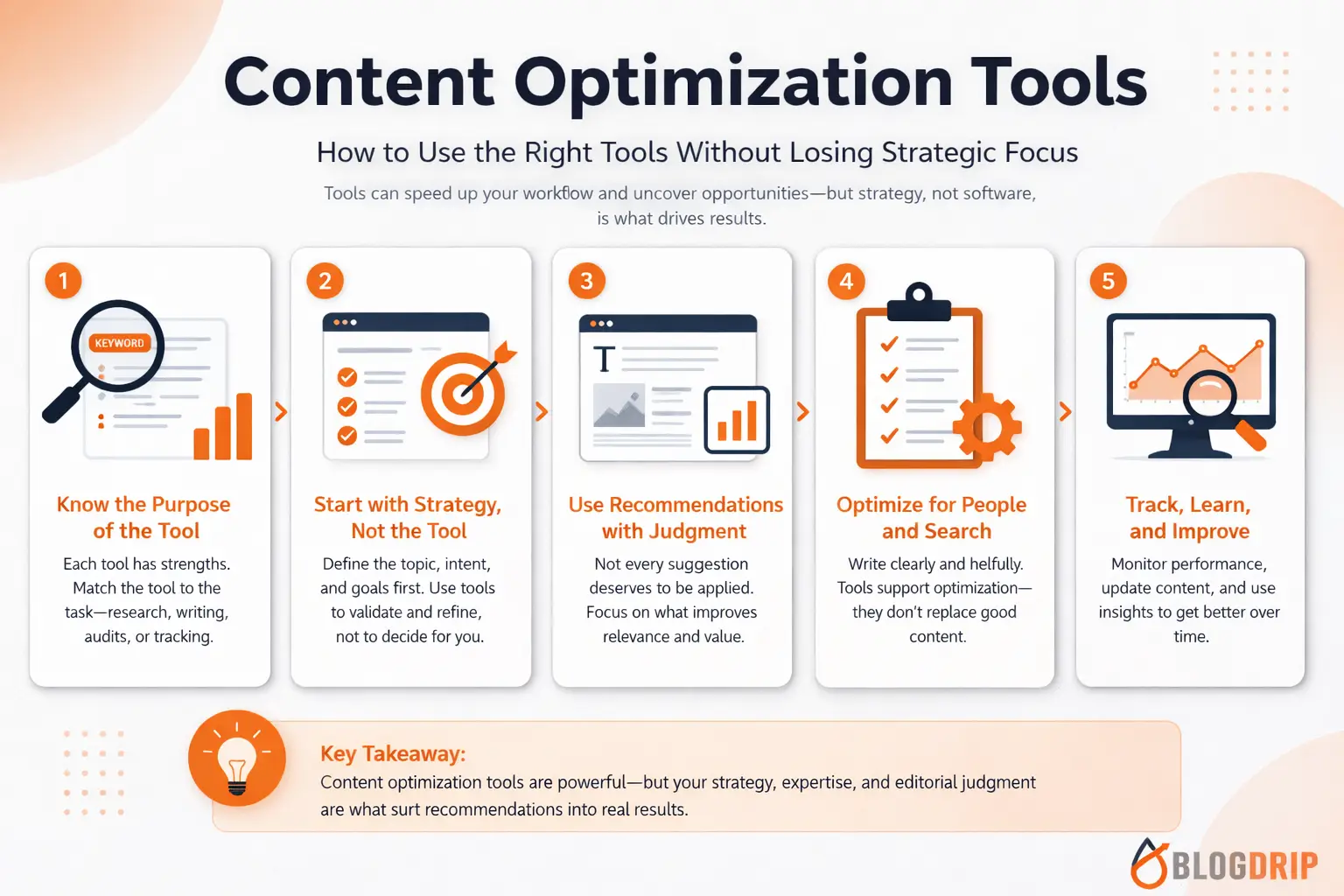
Start with the strategy, not the software. Before opening any tool, define the page’s role, target topic, and search intent. Know whether the page is meant to educate, compare, convert, or support a broader cluster.
Then use the tool to validate and sharpen that direction, not to invent the page from scratch.
It also helps to use tools in sequence. Research tools are useful early. On-page optimization tools are more useful once a draft exists. Audit and internal linking tools become more valuable when reviewing the page in the context of the wider site.
When reviewing tool recommendations, ask three questions:
- Does this suggestion improve usefulness?
- Does it support the page’s actual intent?
- Does it strengthen the page without making it more generic?
If the answer is no, the recommendation does not need to be followed.
For teams, the best use of content optimization tools is often as a quality control layer. They help surface issues, but experienced editors or strategists should make the final call.
Timing and Expectations
Content optimization tools can speed up decisions, but they do not create instant results.
If a page already has some relevance and the tool helps identify meaningful gaps or structural problems, improvements may contribute to performance gains relatively quickly. In more competitive spaces, the effects may take longer and depend on broader factors such as authority, technical health, and internal linking.
The key expectation should be this: content optimization tools improve the process, not the outcome by themselves. The outcome depends on how well the recommendations are interpreted and applied.
Conclusion
Content optimization tools are useful because they make SEO work faster, more consistent, and easier to scale. They can help identify gaps, improve page quality, strengthen content systems, and support more informed decisions.
But they are not a substitute for strategy. The best results come when tools support human judgment rather than replace it.
For websites building topical authority, that distinction matters. A strong cluster is not built by chasing optimization scores. It is built by publishing useful pages, improving them intelligently, and using tools to support better decisions across the content system.
That is the real value of content optimization tools. They help you optimize more effectively, but only when strategy stays in control.