
How to Organize Pages for Better Rankings and Better User Experience
Content structure SEO is often treated as a minor formatting issue, but that misses its real impact. A page can cover the right topic, target the right keyword, and still underperform because the information is poorly organized. When that happens, the problem is not always the content itself. It is the way the page presents that content.
This matters for both users and search engines. Readers need to understand quickly what a page is about, where the answer is, and how the ideas fit together. Search engines need clear signals about the main topic, supporting subtopics, and overall page relevance. Weak structure creates friction for both.
For sites building topical authority through a pillar-and-cluster model, this becomes even more important. Each page needs a clear role within the wider content system. If the page structure is messy, repetitive, or vague, it becomes harder to support the cluster properly.
This is Cluster page content, so the focus here is specific. This article explains what content structure SEO means, why it matters, how it works, which related concepts matter most, what mistakes to avoid, and how to improve structure without overcomplicating the page.
What Is Content Structure SEO
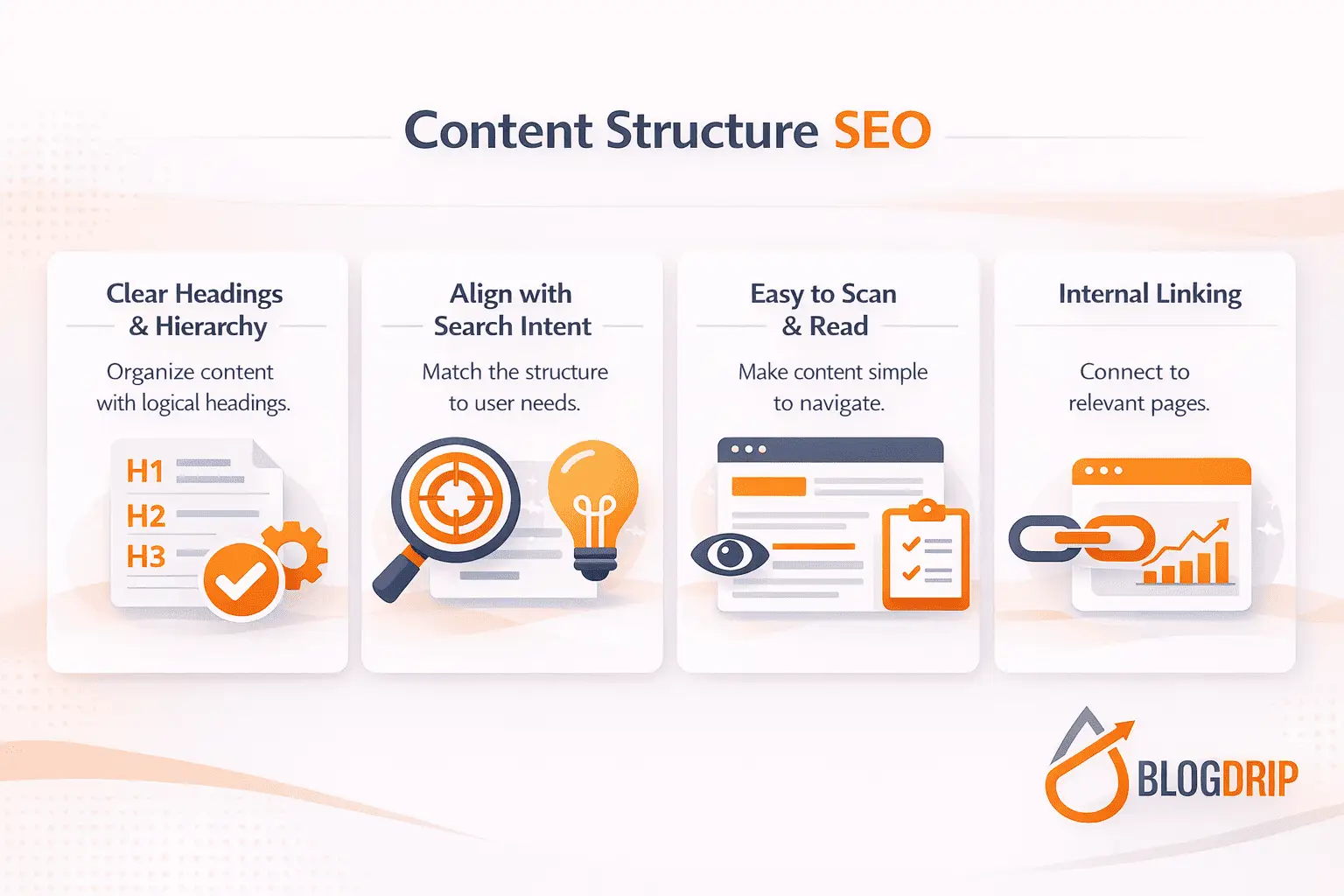
Content structure SEO is the practice of organizing page content so it is clear, logical, easy to scan, and easier for search engines to interpret.
In practical terms, content structure SEO includes:
- the order of sections on a page
- the use of H1, H2, and H3 headings
- the hierarchy between ideas
- paragraph length and readability
- how clearly subtopics are separated
- how the page flows from introduction to conclusion
- where internal links appear within the page
This is not just about visual presentation. Structure affects meaning. It shapes how readers move through the content and how search engines interpret relationships between the main topic and supporting points.
A strong structure makes the page easier to understand. A weak structure hides value, even when the information itself is useful.
Why Content Structure SEO Matters
Content structure SEO matters because search performance depends on clarity as much as coverage.
It improves topical understanding
Search engines look for clear signals about what a page covers. A well-structured page makes the main topic obvious and shows how each section supports it. That helps reduce ambiguity and improves topical focus.
It makes content easier to use
Most users do not read every page word for word. They scan first. They look for section headings, quick answers, and signs that the page is worth their time. If the structure is weak, users may leave before reaching the best information.
It supports stronger engagement
Pages with clear structure are easier to read, easier to navigate, and easier to trust. That often leads to better engagement because readers can move through the content without unnecessary friction.
It strengthens the broader site architecture
Within a cluster model, each page should support the broader topic while remaining clearly distinct from nearby pages. Good structure helps define that role. It makes the page easier to connect internally and easier to position within the wider content ecosystem.
How Content Structure SEO Works
Content structure SEO works by improving how information is arranged on the page.
Start With the Primary Topic
A page needs one clear core topic. Before thinking about headings or section layout, define what the page is actually meant to do.
Ask:
- What is the main query or topic?
- What search intent does the page target?
- What should the user understand by the end of the page?
- Which subtopics belong here, and which belong on separate pages?
If the topic is too broad or unclear, the page structure usually becomes weak as a result.
Build a Logical Heading Hierarchy
The heading structure should reflect the hierarchy of ideas on the page.
The H1 defines the overall topic. H2s should introduce the main sections. H3s should only be used when a section genuinely needs another level of detail.
This matters because heading hierarchy helps both users and search engines understand how the content is organized. It also forces clearer editorial thinking. If the headings are vague, the content usually is too.
Order Sections Around Search Intent
A page should not just be logically organized. It should also be organized in the order users expect.
For an informational page, that usually means starting with a clear explanation, then moving into why it matters, how it works, common issues, and practical guidance. If the page delays the core answer or buries important information too deep, the structure weakens the experience.
Good content structure SEO aligns the order of ideas with the intent behind the search.
Make the Page Easy to Scan
Users should be able to understand the page quickly, even before they read every paragraph.
That means using descriptive headings, manageable paragraph lengths, and clear section boundaries. A page that feels dense or visually flat often underperforms because readers struggle to locate value efficiently.
Important Subtopics Within Content Structure SEO
Content structure SEO overlaps with several other important SEO concepts.
Headings and Content Hierarchy
Headings are one of the clearest structural tools on a page.
Why headings matter
Headings help define the page’s topical map. They show users what each section covers and help search engines interpret the relationship between ideas.
What strong headings do
Strong headings are descriptive, relevant, and useful. They do not exist only to hold keywords. They tell the reader what the section is about and create clear separation between major points.
Search Intent and Content Flow
Structure should reflect user expectations. That means the order of information should make sense for the query.
A user searching for an explanation usually wants a direct answer early. A user looking for practical guidance may need step-by-step organization. A page that ignores this often feels frustrating even if the content is accurate.
Readability and Page Experience
Readability is part of structure, not separate from it.
This includes paragraph length, sentence flow, spacing, and how smoothly one section leads to the next. Strong content structure SEO reduces friction and makes the page feel more coherent.
Internal Linking and Context
A well-structured page also makes internal linking easier and more natural. When sections are clearly defined, links to related supporting pages can appear in the right places without feeling forced.
That helps users move deeper into the topic cluster and strengthens the contextual relationships between pages.
Common Mistakes in Content Structure SEO
Many structural problems appear in predictable ways.
Using headings without real logic
Some pages include headings only for visual formatting. The headings exist, but they do not reflect a clear hierarchy of ideas. That weakens clarity rather than improving it.
Covering too much in one page
A page often becomes structurally messy when it tries to answer too many different questions at once. The result is broad but unfocused content with weak section boundaries.
Writing dense, hard-to-scan blocks
Even good information becomes less effective when it is buried in long, uninterrupted text. Readers need visual and conceptual breaks.
Repeating the same points
Poor structure often leads to duplication. Similar ideas appear under different headings because the page was not mapped carefully before writing.
Forcing keywords into headings
Headings should support understanding first. If they are written only to insert exact-match phrases, the result often feels awkward and weakens the page experience.
Practical Guidance for Improving Content Structure SEO
A good structure starts before the writing begins, but it is also something you can improve later.
Start by defining the page’s purpose clearly. Know what it targets, what the user needs, and how it differs from related pages in the cluster.
Then build an outline that reflects the real hierarchy of the topic. Each section should have a clear role. The order should feel natural. If two sections overlap heavily, they may need to be merged or redefined.
After drafting, review the page as a reader would. Can the topic be understood quickly? Do the headings make sense on their own? Is the answer introduced early enough? Do any sections feel repetitive, misplaced, or too dense?
For existing pages, prioritize improvements where structure is most likely to affect outcomes. That usually means pages with impressions but weak rankings, cluster pages supporting key topics, and pages that already have useful content but poor organization.
Timing and Expectations
Improving content structure SEO can produce results faster than a full rewrite in some cases, especially when the page already has decent content but weak organization.
Still, expectations should remain realistic. Better structure alone will not fix every problem. If the page also has weak search intent alignment, thin coverage, or poor internal support, broader improvements may be needed.
The most realistic expectation is this: stronger structure improves clarity first. That often leads to better usability, stronger topical signals, and a better chance of improved rankings over time.
Conclusion
Content structure SEO is the practice of organizing a page so it is easier to understand, easier to navigate, and easier for search engines to interpret.
That makes it more than a formatting detail. It is a core part of how content communicates relevance and how a page performs within a wider SEO strategy.
For websites building topical authority, strong structure is essential. It helps each page do its job more effectively, supports internal relationships across the cluster, and improves the overall quality of the content system.
That is the real value of content structure SEO. It turns useful information into a clearer, stronger, and more competitive search asset.