
What Is Content Optimization? A Practical SEO Guide for Better Content Performance
Content optimization is one of those SEO terms that gets used constantly but explained poorly. Many people treat it as a quick editing pass: add a few keywords, adjust some headings, rewrite the title, and move on. In practice, that approach is too shallow to produce meaningful results.
If you want content to rank, attract the right audience, and support business goals, optimization has to go further. It needs to improve relevance, structure, clarity, usefulness, and alignment with search intent. It also needs to fit the role that page plays within the wider site.
That is why this topic matters. Businesses often invest heavily in content creation but leave performance on the table because the content is not well optimized. Sometimes the page targets the wrong query. Sometimes it is too broad. Sometimes it has useful information but weak structure, poor internal linking, or unclear topical focus.
This is cluster page content, so the goal here is focused and specific. Rather than covering all of SEO, this article answers a narrower question: what is content optimization, why it matters, how it works, and how to approach it properly.
What Is Content Optimization
Content optimization is the process of improving a page so it performs better for both search engines and users.
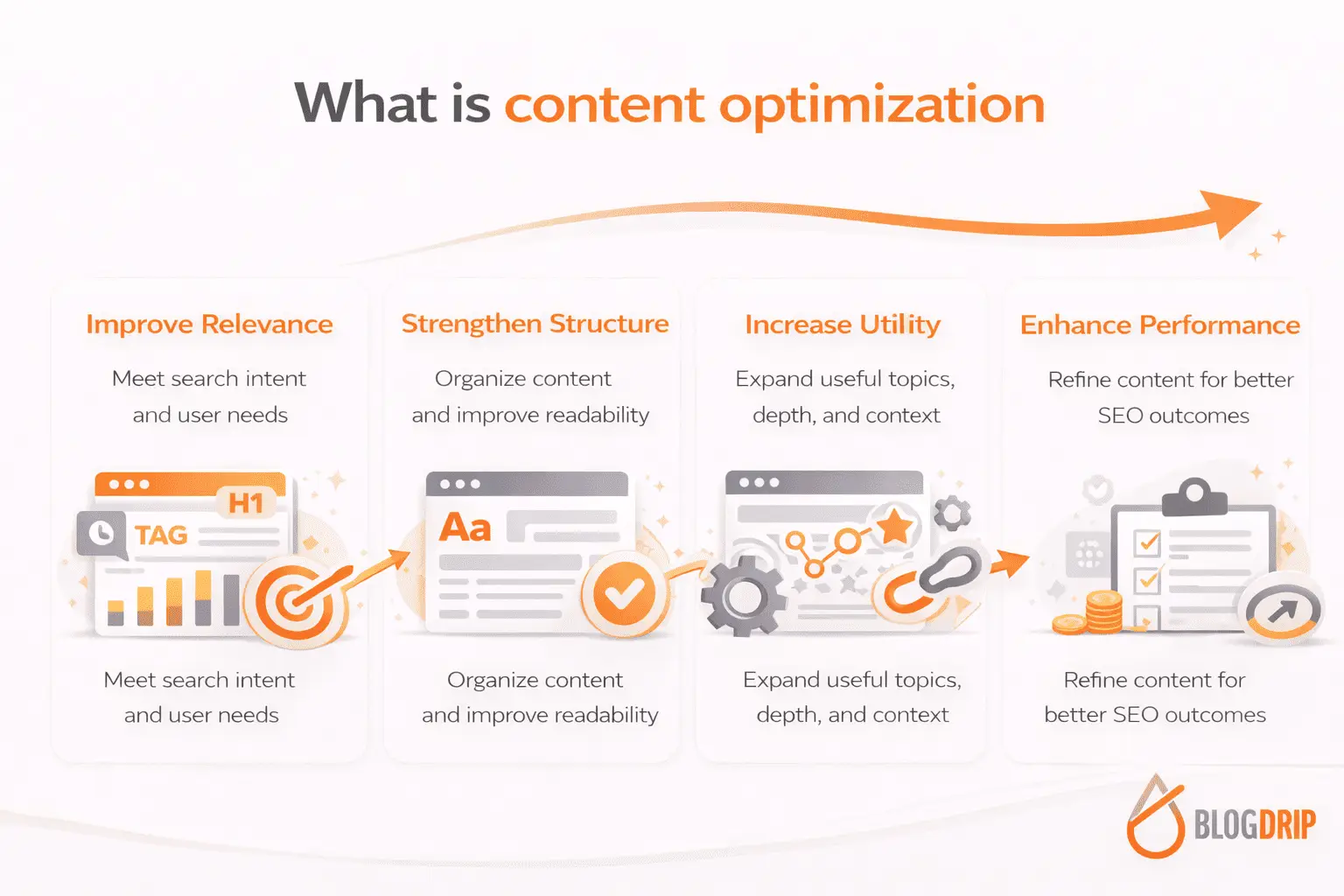
In simple terms, it means making content more relevant, more useful, easier to understand, and better aligned with what someone is actually searching for. That can involve updating the copy, refining headings, improving internal links, expanding missing subtopics, removing weak sections, and making the page easier to navigate.
So when someone asks, “what is content optimization,” the best answer is not “adding keywords.” Keywords are part of it, but content optimization is broader than that. It is about improving the page as a whole.
A properly optimized page should do four things well:
- make the topic clear
- match the likely search intent
- provide enough depth to be genuinely helpful
- support the next logical step for the user
That next step may be reading another article, contacting the business, comparing services, or simply finding a clear answer. The right outcome depends on the page type and intent.
Why Content Optimization Matters
Content optimization matters because organic search is competitive, and weak pages rarely perform well just because they exist.
Search engines compare pages, not just topics. If your page is less useful, less focused, less complete, or less trustworthy than competing results, it will usually struggle. That is true even if the topic itself is important and the site has published regularly.
It improves relevance
A page often underperforms because it does not clearly communicate what it is about. The topic may be too broad, the structure may be confusing, or the content may not answer the real question behind the search.
Optimization improves that relevance by making the page more specific and more aligned with the query.
It supports rankings and organic visibility
Search engines need clearer signals to understand what a page should rank for. Stronger headings, better topical depth, improved internal linking, and more useful content all contribute to that.
This does not guarantee rankings, but it gives the page a stronger chance to compete.
It helps content support business outcomes
Not every page exists only to generate traffic. Some pages should build trust, some should support conversions, and some should strengthen topical authority in a content cluster.
Content optimization helps connect page performance to business value instead of treating content as an isolated publishing task.
It strengthens the wider site structure
Within a pillar-and-cluster model, one weak page can reduce the clarity of the whole topic area. A cluster page should support the broader pillar topic while also holding its own as a useful resource.
That makes content optimization important at both page level and site architecture level.
How Content Optimization Works
To understand what is content optimization in practice, it helps to break it into a process rather than a vague concept.
Start With Search Intent
The first question is not what words to add. The first question is what the user wants.
If someone searches for a definition, they usually want a clear explanation. If they search for a comparison, they want evaluation. If they search for a how-to topic, they want actionable guidance.
A page that targets the wrong intent will often fail even if it is well written. That is why optimization starts with search intent, not with editing.
Clarify the Page’s Main Focus
Many pages underperform because they try to do too much. They define the topic, explain advanced tactics, sell a service, and answer unrelated questions all on one page.
A better approach is to define the page’s role clearly. Ask:
- What is the main keyword or topic?
- What question should this page answer?
- Is this meant to be broad or specific?
- Where does it sit in the site’s content structure?
If the answers are not clear, the content usually needs stronger focus before anything else.
Improve Structure and Readability
Content optimization often involves improving how information is organized.
That includes:
- stronger H1 and H2 headings
- clearer section order
- shorter paragraphs
- better transitions between ideas
- less repetition
- more direct explanations
A page can contain good information and still perform poorly if the structure makes it hard to follow.
Strengthen Topical Coverage
This is where many people misunderstand optimization. The goal is not to add more words for the sake of length. The goal is to cover the topic well enough that the page feels complete for its intended purpose.
That may mean adding missing explanations, examples, related concepts, or practical detail. It may also mean removing filler that weakens focus.
Refine Internal Linking
A page should not stand alone if it belongs in a topic cluster. Internal links help search engines understand relationships between pages and help users move logically through the site.
For example, a page answering what is content optimization may naturally connect to related content on search intent, on-page SEO, internal linking, content audits, or content strategy.
Important Subtopics Within Content Optimization
Content optimization sits close to several related SEO disciplines. Understanding those connections helps explain why it is more strategic than basic editing.
Search Intent Alignment
Search intent is the foundation of strong optimization. Without it, even a well-polished page can miss the mark.
A page should reflect what users are actually trying to achieve. That includes the depth they expect, the format they prefer, and the kinds of questions they want answered.
If intent is wrong, adding semantic terms or rewriting headings will not solve the core problem.
On-Page SEO
On-page SEO is part of content optimization, but not the whole thing.
Title tags, headings, metadata, URLs, and image optimization all matter because they help clarify page relevance. But content optimization goes further by looking at content quality, usefulness, and alignment with user need.
That distinction matters. A technically optimized page is not always a strategically optimized page.
Topical Depth and Content Quality
A strong page should show real understanding of the topic. That does not mean complexity for its own sake. It means covering the subject with enough depth, nuance, and clarity to be genuinely useful.
Thin content often fails because it offers a surface-level answer to a question that deserves more. Strong content optimization closes that gap.
Internal Linking and Context
Search engines understand pages partly through their context. Internal links help define that context.
If a page is well optimized but poorly connected, it may still struggle. That is why internal linking is part of content optimization, not just a technical add-on.
Common Mistakes
When people ask what is content optimization, they often assume it is a simple checklist. That leads to predictable mistakes.
Treating optimization as keyword stuffing
This is the most obvious mistake. Repeating the target phrase unnaturally does not make content stronger. It usually makes it worse.
Good optimization uses keywords naturally while focusing on clarity, relevance, and completeness.
Updating language without fixing intent
A page can be rewritten beautifully and still fail if it targets the wrong query or the wrong page type. Optimization has to address strategic fit, not just wording.
Adding length without adding value
More words do not automatically create a better page. Many pages become less effective when they are padded with generic advice, repetitive sections, or weak FAQs.
Ignoring structure
A confusing page structure hurts readability and makes the topic harder to interpret. If the information is buried, scattered, or poorly ordered, users will feel it and search engines may too.
Forgetting the wider site
Content optimization should support the larger content ecosystem. If a page overlaps with other pages, lacks internal links, or sits awkwardly in the cluster structure, performance can be limited.
Practical Guidance for Doing It Well
A realistic approach to content optimization starts with diagnosis.
Review the page before changing anything. Look at what it currently targets, how it is structured, what questions it answers, and where it falls short. Compare that with the likely intent behind the query and with the standard set by strong pages already ranking.
Then improve the page in layers.
Start with the page’s purpose. Clarify what it should rank for and what role it plays. After that, improve the structure. Then strengthen the substance by filling topical gaps, tightening weak sections, and improving clarity. Finally, review internal links and user flow.
It is also useful to prioritize pages rather than trying to optimize everything at once. Pages that already have impressions, pages close to page one, and pages tied to important business topics often offer the best return.
Good content optimization is rarely dramatic. It is usually careful, specific, and evidence-based.
Timing and Expectations
Content optimization can improve performance, but it is not instant.
Some pages show gains fairly quickly, especially if they already have relevance and just need stronger alignment or clearer structure. Others take longer, particularly in competitive spaces or on websites with limited authority.
Several factors influence timing:
- the strength of the site overall
- the size of the content changes
- crawl and indexation frequency
- the competitiveness of the topic
- whether the page now matches intent more effectively
The right expectation is improvement over time, not immediate transformation. Optimization works best as an ongoing process, not as a one-time fix.
Conclusion
So, what is content optimization?
It is the process of improving a page so it better serves search intent, communicates topical relevance more clearly, delivers a stronger user experience, and contributes more effectively to organic performance.
That makes it far more strategic than basic editing. Content optimization is about making a page more useful, more focused, and more competitive within the context of the wider site.
For businesses building topical authority, this matters. Strong content does not happen by publishing alone. It comes from refining important pages, aligning them with real user needs, and strengthening how they fit into the broader content structure.
That is the long-term value of content optimization. It helps turn content from a publishing output into a durable SEO asset.