
How to Improve Existing Pages for Better SEO Performance
To optimize content well, you need more than a checklist. Many teams update headings, add keywords, expand sections, and refresh metadata, yet the page still does not perform better. That usually happens because the work focused on surface signals rather than the real issue.
A page may underperform because it targets the wrong intent, covers the topic too lightly, overlaps with another page, or sits weakly inside the wider site structure. If those problems are not diagnosed first, optimization becomes activity without progress.
That is why this topic matters. For websites building topical authority through a pillar-and-cluster model, content optimization is not simply about polishing copy. It is about making each page more useful, more relevant, and more effective within the broader content ecosystem.
This is Cluster page content, so the scope here is focused. This article explains what it means to optimize content, why it matters, how it works, what supporting concepts influence it, what mistakes to avoid, and how to approach optimization strategically.
What Is Optimize Content
To optimize content means improving a page so it becomes more relevant to its target query, more useful for the reader, and more effective as part of the site’s SEO strategy.
In practical terms, content optimization can include:
- improving page structure
- clarifying the main topic
- aligning the page with search intent
- strengthening topical depth
- updating outdated information
- refining internal links
- improving readability
- removing weak or unnecessary sections
This is not the same as adding more words or repeating a keyword more often. Strong optimization improves the page itself, not just its visible SEO signals.
That distinction matters. A page can look optimized in a tool and still fail because it does not actually answer the user’s need well enough. Real optimization improves both relevance and usefulness.
Why It Matters
To optimize content strategically is one of the most reliable ways to improve organic performance without starting from zero.
It improves topical relevance
Search engines need to understand what the page is about and why it deserves to rank for a given query. Strong optimization makes that clearer through better structure, language, and topic coverage.
It supports stronger rankings
A page does not rank in isolation. It competes against other pages targeting the same topic. If competing content is clearer, more complete, or better aligned with search intent, your page will struggle. Optimization helps close that gap.
It gets more value from existing assets
Many websites already have pages with potential. They may be ranking on page two, receiving impressions without enough clicks, or attracting traffic without satisfying users fully. Improving those pages is often more efficient than producing more content without review.
It strengthens the wider topic cluster
Within a pillar-and-cluster model, every page supports a broader topic area. A weak cluster page does not just fail on its own. It can reduce the clarity and strength of the entire cluster.
How to Optimize Content
To optimize content effectively, start with diagnosis rather than editing. The page has to be understood before it can be improved.
Start With the Page’s Role
Every page should have a clear job.
Define the page purpose
Ask what the page is meant to do. Is it answering an informational question, supporting a pillar page, targeting a long-tail variation, or helping move the user deeper into the site?
Keep one primary intent
A page usually performs best when it serves one main intent. If it tries to educate, define, compare, and sell all at once, the result often becomes diluted.
Review Search Intent
Search intent should shape almost every optimization decision.
Check what users expect
Look at the type of pages that rank for the target query. Do users want a guide, a definition, a comparison, or a service page? If your page does not match that expectation, optimization needs to address that first.
Align depth and format
Some topics need concise answers. Others need layered explanation and practical detail. A page can be accurate and still underperform if the format is wrong for the search.
Improve Structure First
A surprising number of weak pages are structurally weak before they are editorially weak.
Strengthen headings and hierarchy
A clear H1 should define the topic. H2s should break it into logical sections. H3s should only be used when they genuinely improve clarity.
Reorder ideas logically
Important information should appear where readers expect it. If the key answer is buried too deep, the page creates friction.
Reduce repetition
Optimization often includes cutting content, not just adding it. Repetitive sections make a page feel longer without making it more useful.
Improve the Substance
Once the structure is clear, the content itself needs review.
Fill real gaps
If the page is missing important subtopics, examples, or practical detail, add them.
Remove weak sections
Some sections weaken the page because they are too vague, too broad, or only loosely related to the main topic.
Update outdated material
Old references, stale examples, and outdated assumptions can reduce trust even when the topic is still relevant.
Important Supporting Concepts
To optimize content well, you need to think beyond the page in isolation. Several related SEO concepts shape what good optimization looks like.
Search Intent and Query Fit
Search intent is foundational because it determines whether the page is solving the right problem.
Why it matters
A page that targets the wrong intent will struggle no matter how polished it looks. If the user wants a practical guide and the page provides only a broad overview, optimization at the sentence level will not solve the real issue.
What it changes
Sometimes the right optimization is not expansion. Sometimes it is narrowing the page, clarifying the angle, or repositioning the content for a better fit.
On-Page SEO
On-page SEO supports optimization, but it should not replace strategy.
Titles and headings
These help clarify topic focus and improve page structure. They should support readability as much as relevance.
Keyword use
Keywords still matter, but strong optimization uses them naturally. The goal is topical clarity, not repetition.
Internal Linking
A well-optimized page should fit its surrounding content more effectively.
Support the cluster
Cluster pages should connect naturally to relevant supporting pages and, where appropriate, back to the pillar. This helps reinforce topical relationships.
Improve discoverability
Internal links help search engines understand which pages matter and how the content system fits together.
Content Freshness
Some pages underperform because they are no longer current enough. Updating terminology, examples, and assumptions can improve both trust and usefulness.
Common Mistakes
When teams try to optimize content, they often make the same errors.
Optimizing Without Diagnosis
This is the most common mistake. Teams update titles, headings, or keywords without identifying what is actually holding the page back.
Adding More Instead of Improving More
Longer content is not automatically stronger content. Expansion without purpose often makes the page heavier and less focused.
Ignoring Search Intent
A page can be technically cleaner and still fail because it answers the wrong need. Intent mismatch is often a bigger problem than on-page formatting.
Overusing Keywords
Trying too hard to signal relevance often damages readability. Keywords should support the content naturally, not dominate it.
Overlapping With Nearby Pages
A page may underperform because it competes with another page on the same site. Good optimization should clarify the page’s role, not create more cannibalization.
Practical Guidance
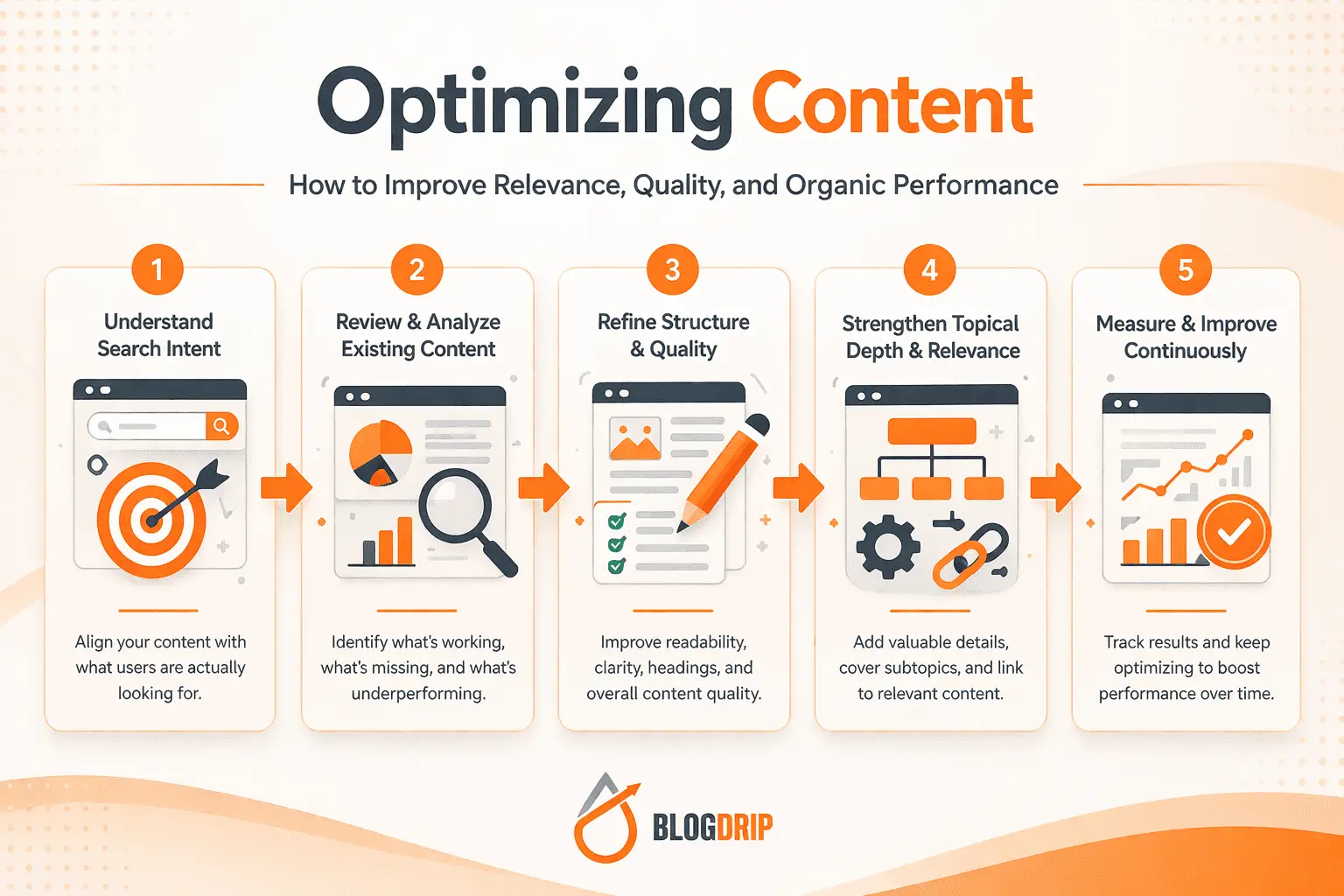
A practical way to optimize content is to work in layers.
Start by prioritizing the right pages. Focus on pages that already have impressions, support important business topics, or sit inside valuable topic clusters. These usually offer the strongest return.
Then assess each page honestly. Review intent alignment, structure, topical depth, freshness, internal linking, and how well it fits the wider content architecture. Decide what kind of optimization the page actually needs. Some pages need a light refresh. Others need restructuring or a full rewrite.
As you optimize, keep the page’s role clear. A cluster page should stay focused. It should support the broader site architecture without trying to rank for every related phrase.
It is also smart to think in cycles rather than one-off fixes. Search results change, competitors improve, and user expectations evolve. Strong optimization reflects that reality.
Timing and Expectations
When you optimize content, results can appear faster than creating new pages from scratch, but expectations should still remain realistic.
If a page already has some relevance and the improvements significantly strengthen intent match, structure, or usefulness, gains can appear within weeks. In more competitive spaces, the impact may take longer and depend on site authority, internal linking, and topic difficulty.
The most realistic expectation is steady improvement. Content optimization works best as an ongoing process rather than a one-time event.
Conclusion
To optimize content well is to improve a page so it becomes more relevant, more useful, and more effective within the wider SEO strategy.
That means optimization is not just about keywords, metadata, or length. It is about understanding the page’s purpose, matching search intent, improving structure, strengthening substance, and helping the page fit more effectively within the broader topic cluster.
For websites building topical authority, this matters at every level. Strong content systems are not built only by publishing more. They are built by improving existing pages thoughtfully and making sure each page continues to earn its place.
That is the long-term value of choosing to optimize content strategically. It turns existing pages into stronger SEO assets instead of leaving them to underperform quietly.