
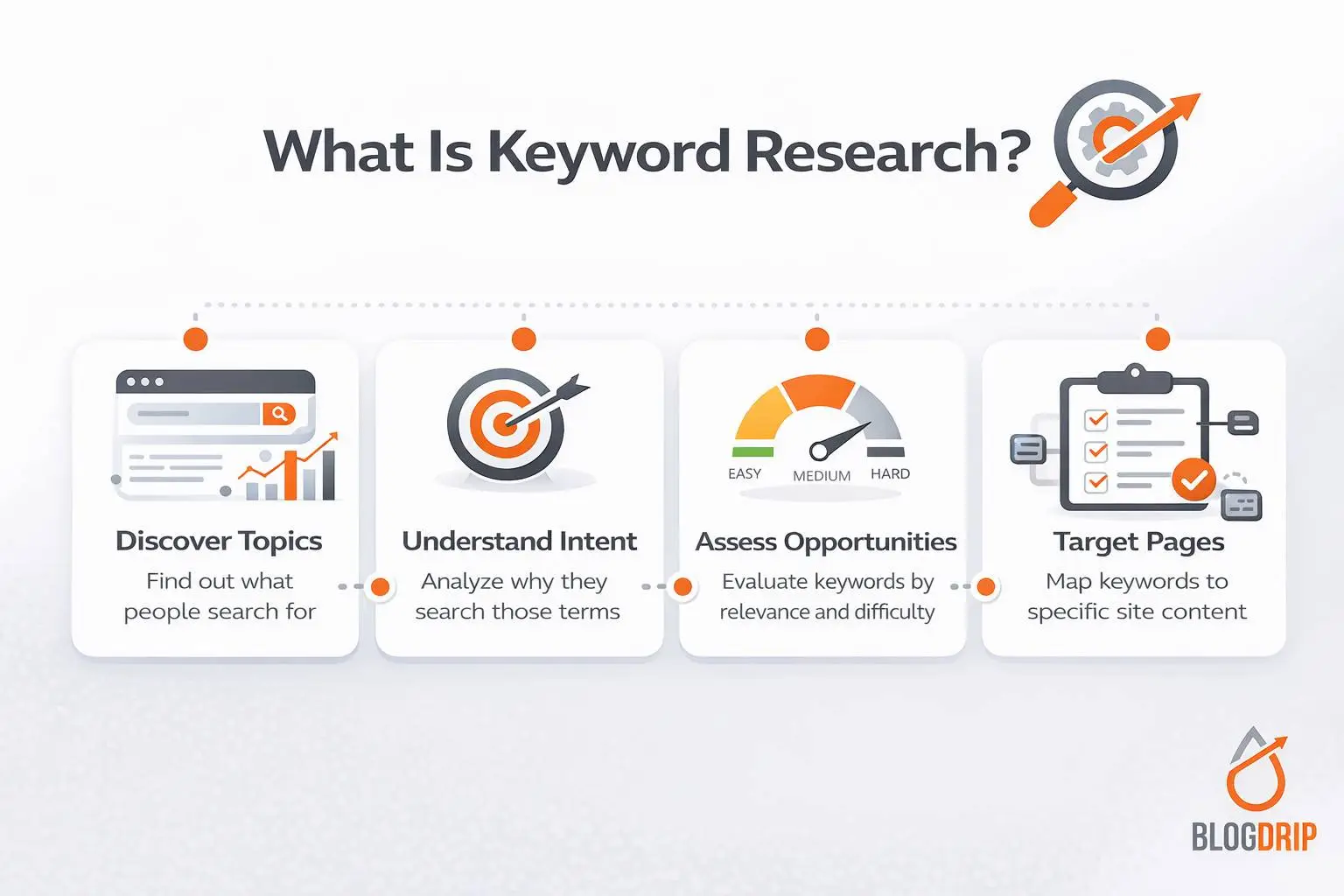
What Is Keyword Research?
Keyword research is the process of identifying the words, phrases, and topics people use in search engines, then deciding which of those terms your website should target. At a basic level, that sounds simple. In practice, it is one of the most important strategic activities in SEO because it influences what content you create, how pages are structured, and which opportunities are worth pursuing.
Many businesses treat keyword research as a spreadsheet task. They gather search terms, sort by volume, and start writing. That usually leads to weak results. Good keyword research is not about collecting as many phrases as possible. It is about understanding demand, intent, relevance, and competition so you can build pages that genuinely match what searchers want.
For websites using a pillar-and-cluster model, keyword research also plays a structural role. It helps define which topics deserve a broad pillar page, which subtopics should become supporting cluster articles, and how those pages should connect through internal linking. That is what turns content into a coherent SEO asset rather than a collection of isolated blog posts.
What Is Keyword Research in Practical Terms?
Keyword research is the process of finding out how your audience searches online and using that information to shape your SEO strategy.
In practical terms, it answers questions like these:
- What topics are people searching for?
- Which phrases reflect real demand?
- What does the searcher want when they type that query?
- Which keywords are realistic for this site to target?
- Should this topic be a pillar page, a cluster page, or part of an existing article?
A keyword itself is not just a phrase. It represents a need, a goal, or a question. Someone searching “what is keyword research” is usually looking for a clear explanation, not a service page or a tool landing page. Someone searching “best keyword research tools” likely wants comparisons. Someone searching “keyword research agency” may be much closer to a commercial decision.
That distinction matters because modern SEO is built around intent, not just terms.
Why Keyword Research Matters
Keyword research matters because it connects your website to real search behavior. Without it, content strategy often becomes guesswork.
A business may publish articles based on internal assumptions, industry jargon, or topics that feel important internally but do not reflect how users actually search. The result is often content that is well written but poorly aligned with demand.
It helps you target the right topics
Not every topic deserves a page. Keyword research helps identify which subjects people actively search for and which angles are worth developing into content.
That does not mean every valuable topic must have high volume. Some lower-volume queries are highly specific, easier to rank for, and more aligned with qualified traffic.
It improves intent alignment
A page can fail even when it targets the right keyword if the format does not match what the searcher expects. Keyword research helps you see whether a query calls for a guide, a definition page, a category page, a comparison article, or something else entirely.
For this keyword, the search intent is informational, so the job of the page is to explain the concept clearly and usefully.
It supports topical authority
Keyword research is also how you move from single articles to topic coverage. A strong website does not only publish one page about SEO and hope it ranks. It builds clear topical relationships.
For example, a pillar page on Keyword Research can link naturally to cluster content on:
- what keyword research is
- search intent
- long-tail keywords
- keyword difficulty
- keyword clustering
- keyword mapping
That kind of structure helps search engines understand both breadth and depth.
How Keyword Research Works
Keyword research is best understood as a process rather than a single tool or report.
It starts with a topic
Most keyword research begins with a broad topic area that matters to the audience and fits the site’s expertise. That topic might be keyword research, local SEO, content strategy, or technical SEO.
From there, you expand into related queries, questions, and subtopics.
For example, the broad topic “Keyword Research” can lead to related searches such as:
- what is keyword research
- how to do keyword research
- keyword research tools
- keyword research for SEO
- keyword research examples
Not all of these terms should be targeted on the same page. That is where evaluation matters.
It moves from terms to intent
Once you have a set of keyword ideas, the next step is to understand intent. Search engines reward pages that best satisfy the purpose behind a query.
If users searching a term consistently see beginner guides, then an advanced technical breakdown may not match what the search results are signaling. If the results are dominated by product pages, an educational article may struggle.
Keyword research is therefore not just about finding phrases. It is about interpreting what kind of page deserves to exist.
It involves prioritization
After identifying relevant keywords, you need to decide which ones are worth targeting. That usually depends on a mix of factors:
Relevance
The keyword should fit your business, audience, and expertise. Traffic has limited value if it attracts people who are not a good fit for your site.
Competition
Some keywords are dominated by highly authoritative sites with strong existing content. That does not always make them impossible, but it does affect the strategy.
Search intent
The intent needs to match the type of page you plan to create.
Strategic role
Some keywords belong on a pillar page, while others are better suited to cluster content. Keyword research helps make that distinction clear.
Important Concepts Behind Keyword Research
To understand what keyword research really is, it helps to look at the related concepts that shape it.
Search intent
Search intent is the reason behind a search. It is one of the most important parts of keyword research because it determines the kind of content that should rank.
There are several common intent types, but for SEO content planning, the most important distinction is often whether the search is informational, commercial, or transactional.
The keyword “what is keyword research” is clearly informational. The user wants a definition and explanation. That means the page should educate rather than sell.
Long-tail keywords
Long-tail keywords are more specific phrases that usually have lower search volume but clearer intent. They often reflect more detailed needs and can be strong opportunities for cluster pages.
For example, a broad keyword like “keyword research” may belong on a pillar page, while a more specific query like “what is keyword research” makes sense as a focused supporting article.
Long-tail keywords are often easier to target because they are narrower and allow more precise content alignment.
Keyword clustering
Keyword clustering is the process of grouping related search terms that can be addressed on one page.
This matters because not every variation needs its own article. Separate pages for very similar keywords can cause keyword cannibalization, weak content, and site bloat.
A strong cluster page should cover the primary query and closely related variations naturally, without forcing separate URLs for every version.
Keyword mapping
Keyword mapping is the step where research becomes site structure. It involves assigning keywords or keyword clusters to specific pages.
This helps ensure that:
- each major topic has a clear home
- supporting pages have a distinct purpose
- internal links reinforce the cluster structure
- multiple pages are not competing for the same term
Without keyword mapping, even good research can turn into scattered content production.
Common Mistakes When Defining Keyword Research
A lot of confusion around keyword research comes from oversimplified definitions. People understand the phrase at a surface level but miss its strategic role.
Mistaking it for a keyword list
Keyword research is not just a collection of phrases pulled from a tool. The list itself is only raw material. The value comes from analysis, grouping, prioritization, and application.
Focusing only on search volume
Search volume matters, but it does not tell the whole story. A lower-volume query with clear intent and strong relevance can be far more valuable than a broad term that attracts the wrong audience.
Ignoring how pages fit together
Keyword research is often treated as if each keyword leads to one page and each page stands alone. That is not how strong SEO architecture works. Pages should support broader topic coverage and connect logically through internal links.
Treating research as a one-time task
Search behavior changes. Search results change. Competitors improve. Keyword research should be revisited over time, especially when a site is expanding its content cluster or updating existing pages.
Practical Guidance for Using Keyword Research Properly
If you want keyword research to improve SEO performance, use it as a decision-making process rather than a content checklist.
Start with the audience and the topic. Think about what they want to know, how they phrase that need, and what type of content would satisfy it. Then review the search results carefully before deciding what to publish.
For an informational query like “what is keyword research,” the strongest approach is usually:
- define the concept clearly
- explain why it matters
- show how it works in practice
- connect it to related concepts without turning the page into a full pillar article
That last point is important. A cluster page should support the main pillar page, not duplicate it. This article should answer the specific question well, then naturally point readers toward broader related topics such as keyword strategy, search intent, or keyword mapping.
Timing and Expectations
Keyword research helps you make better SEO decisions early, but it does not create rankings by itself. Results still depend on execution.
A well-researched article has a better chance of ranking because it targets a real query, matches intent, and fits into a stronger site structure. But rankings also depend on content quality, internal linking, technical health, and the authority of the site.
That is why keyword research should be viewed as a foundation. It improves the quality of the strategy, which then improves the quality of the content and structure built on top of it.
Conclusion
So, what is keyword research?
It is the process of discovering how people search, understanding what they mean, and using that insight to decide what your website should publish and how it should be structured. It is both a content planning activity and a strategic SEO discipline.
The strongest keyword research does more than find phrases with traffic potential. It clarifies search intent, identifies realistic opportunities, prevents wasted effort, and supports the kind of topic architecture that builds long-term authority.
For a website growing through a pillar-and-cluster model, keyword research is not optional. It is the framework that helps every page serve a clear purpose.